
Introduction – getting off the beaten path
This article concentrates on Shimane and Tottori prefectures but because of the rail lines we feature we also dip into Hiroshima, Hyogo and Okayama Prefectures a little.
It is not the purpose of this article to provide you with an itinerary but instead to give you some ideas, wet your appetite and of course to highlight a very scenic and interesting area of Japan.
Table of Contents
San’in is made up of Shimane, Tottori, and part of Yamaguchi Prefectures. It forms part of the wider Chugoku region in the western part of Honshu, Japan’s main island.
San’in is often called the “shadow of the mountains,” while San’yo is known as the “sunny side of the mountains.” This position on the shadow side has made San’in a land steeped in mysteries and folklore.
The region is very rural, with an abundance of mountains, forests, and rivers. Mt. Daisen, one of Japan’s sacred mountains, rises prominently here. Facing the rugged Japan Sea, the area features the striking Kaigan Coastline, the scenic waterways of Matsue, and the sweeping Tottori Sand Dunes. The rail lines that crisscross the region take travelers through, around, and along many of these landscapes.
San’in is also home to many cultural treasures, including Izumo Taisha, Matsue Castle, and the Iwami Silver Mine. Historically, the region was a center for samurai sword-making using tatara steel and is also known for its traditional washi papermaking. The Kagura sacred dance, particularly celebrated in Tottori, is another cultural highlight.
The area hosts a wide variety of local festivals. These include the Tottori Shan Shan Festival in August, the Yonago Gaina Festival (also in August), and the Suigo-sai Festival in Matsue with its spectacular fireworks over Lake Shinji. Equally famous is the Iwami Kagura Festival in autumn, the spiritual home of the Kagura dance. These are just a few of the many celebrations; throughout the summer months, visitors can also enjoy numerous firework displays.
San’in is also proud of its local cuisine, which features—but is not limited to—fresh seafood from the Sea of Japan.
Another defining feature of the region is its relative isolation. With no shinkansen access, it remains far less crowded than destinations such as Kyoto, Tokyo, or Osaka. Yet, as this article shows, the long travel times are not wasted—the journey itself is part of the experience.
Sanin Tourist Information: https://sanin-japan.com
Why visit the Sanin region?
San’in is made up of Shimane, Tottori, and part of Yamaguchi Prefectures. It forms part of the wider Chugoku region in the western part of Honshu, Japan’s main island.
San’in is often called the “shadow of the mountains,” while San’yo is known as the “sunny side of the mountains.” This position on the shadow side has made San’in a land steeped in mysteries and folklore.
The region is very rural, with an abundance of mountains, forests, and rivers. Mt. Daisen, one of Japan’s sacred mountains, rises prominently here. Facing the rugged Japan Sea, the area features the striking Kaigan Coastline, the scenic waterways of Matsue, and the sweeping Tottori Sand Dunes. The rail lines that crisscross the region take travelers through, around, and along many of these landscapes.
San’in is also home to many cultural treasures, including Izumo Taisha, Matsue Castle, and the Iwami Silver Mine. Historically, the region was a center for samurai sword-making using tatara steel and is also known for its traditional washi papermaking. The Kagura sacred dance, particularly celebrated in Tottori, is another cultural highlight.
The area hosts a wide variety of local festivals. These include the Tottori Shan Shan Festival in August, the Yonago Gaina Festival (also in August), and the Suigo-sai Festival in Matsue with its spectacular fireworks over Lake Shinji. Equally famous is the Iwami Kagura Festival in autumn, the spiritual home of the Kagura dance. These are just a few of the many celebrations; throughout the summer months, visitors can also enjoy numerous firework displays.
San’in is also proud of its local cuisine, which features—but is not limited to—fresh seafood from the Sea of Japan.
Another defining feature of the region is its relative isolation. With no shinkansen access, it remains far less crowded than destinations such as Kyoto, Tokyo, or Osaka. Yet, as this article shows, the long travel times are not wasted—the journey itself is part of the experience.
Sanin Tourist Information: https://sanin-japan.com
Exploring San’in by Train
Exploring San’in by train means: travelling through the forests, along the rivers and coast lines, around the mountains and lakes and by villages and lakes!

The reality is that many areas of Japan are written off by inbound visitors because “it is a 3 hour train journey” and although time is of course a factor, what many people do not realise is that the journey itself is part of the experience of visiting Japan.
Of course planning is essential when you are exploring areas like San’in by train, but the planning is also part of the discovery process.
Getting there…is part of the experience!
Although travelling by shinkansen is not very exciting; travel on the conventional lines, whether by Limited Express train, local train or tourist train can be completely different, and travelling to and from San’in by train means you can start your experiencing the beauty of Japan from Kyoto or Okayama (if not before). Travel time equals Japan Experience 6 Sightseeing Time!
There are two ways we would recommend getting to or from the San’in region:
Hakubi Line – Limited Express Yakumo
The Hakubi Line runs between Kurashiki and Hokidaisen, although trains run to / from Okayama in the South and to / from Yonago in the North.
A popular train to use is the Limited Express Yakumo which runs between Okayama~Kurashiki~Niimi~Yonago~Matsue~Izumoshi. In 2024 the train was upgraded with new train units featuring comfortable interiors (including compartments in the Green Class section) and a new external livery…

But…the important thing is that from the comfort of the train you can see the amazing scenery as the train travels from Sanyo, through the mountains, along the Takahashi & Hiino Rivers.


Near the end of the line, just before in joins the Sanin Main Line, the train passes Mt Daisen. Mt Daisen is a dormant volcano and the highest mountain in the Chugoku region. It also has a major sacred Budhist site, being home to the Shugendo sect and the Daisen-ji (temple) dates back to the year 718.
The Limited Express Yakumo takes 2hrs 15 mins to get to Yonago; 2hrs 45 mins to get to Matsue and 3hrs 6mins to Izumoshi all from Okayama.
Sanin Main Line from Kyoto – the scenic coastal route
The Sanin Main Line is the longest railway line in Japan stretching the nearly 674km from Kyoto to Hatabu in Yamaguchi Prefecture mostly along the Japan Sea Coast. Unfortunately there are no regular trains that run along the length of the line.
If you are starting or ending your San’in journey in Kyoto, using the Sanin Main Line route to get to Tottori, Yonago and Matsue is a good slow scenic way to do it. You can get a Limited Express train to Kinosaki Onsen, and then use local trains to travel on to Tottori. Shortly after leaving Kinosaki Onsen the train travels nears to the Japan Sea Coast so you do get some good views of the Sanin Kaigan Coast Line which is known dramatic coastline, interesting rock formations, fishing villages and even sandy beaches.


Also on this route are the towns of Hamasaka, Kusumi and Takeno as well as Amarube Bay, but as these are all in Hyogo Prefecture we will not say too much about them in this article!
Once you are in the San’in region, the San’in Main Line links Tottori, Yonago, Matsue and Izumo. Between Matsue and Izumoshi the line runs some of the way along the southern side of Lake Shinji.
There are both local trains (generally operate Tottori~Kurayoshi; Kurayoshi~Yonago; Yonago~Matsue & Izumoshi) and Limited Express Trains (Super Oki & Super Matsukaze: Tottori~Izumoshi and through to / from Masuda & Yamaguchi; Yakumo: Izumoshi~Yonago and to / from Okayama) and the tourist train Ametuchi.
Sunrise Express Night Train- 12 hours to / from Tokyo

Another alternative to get to / from the San’in region, particularly if coming from the Kanto area is the overnight Sunrise Express Izumo. The journey time is about 12 hours.
The Sunrise Izumo with the Sunrise Seto are the only regular sleeper train services operating in Japan. (TSJR article on the Sunrise Express)
This is a popular train however so can be hard to get reservations.
Tourist Train “Ametuchi”
The Tourist train “Ametuchi” is operated by JR West on three routes in the Sanin area, between Tottori and Kinosaki Onsen (Sanin Main Line); Tottori~Izumoshi (Sanin Main Line); Yonago~Izumo Yokota (Sanin Main Line & Kisuki Line). It has Green Car seating arranged in a way to maximise viewing of the passing scenery.
“Ametuchi” means “Heaven and Earth” and comes from Japan’s oldest history book, The Kojiki. Many of Japan’s myths and legends which are detailed in the book come from the San’in Region. The design concept of the train is Sanin’s natural beauty and cultural roots.


For more information about the Ametuchi Tourist Train see here:
https://www.westjr.co.jp/global/en/train/ametuchi/ (English)
https://www.jr-odekake.net/railroad/kankoutrain/ametuchi/ (Japanese)
The train mainly operates on weekends, holidays and some Mondays with one return journey a day. It runs on only one route on days of operation. Please refer to JR West information to determine days of operation and operating route
Important Places in San’in to Visit (Tottori & Shimane)
Tottori
Tottori is best known for its famous Sand Dunes. They are a natural phenomenon caused by the sea currents pushing sand back to shore. The sand actually originates from erosion of the mountains in the Chugoku region that gets carried to the sea by the rivers, but then because of the sea currents and winds gets pushed back onto land along the part of the Kaigan coast line close to Tottori city and accumulates. The Dunes are “living” and constantly changing under the influence of the wind and sea. There is also the Sand Museum
Jinpukaku Mansion & Tottori Castle Ruins. Jinpukaku was built for Emperor Taisho in the French renaissance style . the castle ruins are nearby, a popular spot for sakura viewing.


Tourist Information: https://www.japan-guide.com/e/e8100.html
Yonago
Yonago is the Gateway to Mt Daisen, which as well as being very sacred is also popular for hiking and photography.
Yonago is also not far from Sakai Peninsula and close to Sakai Minato which features “Mizuki Shigeru Road”, dedicated to one of Japan’s famous manga artists, with 177 bronze statues of “yokai” (spirit creatures) lining the street. In fact the JR Sakai Line trains are decorated with Konan Manga characters, and Platforms 0 & 1 also a celebration of the “GeGeGe no Kitaro” Manga.
Yonago is also an interesting stop for rail enthusiasts. The Yonago Depot is adjacent to the station and you can seea collection of diesel and electric multiple units and sometimes you can also see snow ploughs and other interesting trains. Outside the station there is an interesting railway related monument commemorating the birth of the Sanin Railway. The statue was inspired by Kenji Miyazawa’s famous fairy tale “Night on the Galactic Railroad”.


Tourist Information: https://www.japan.travel/en/destinations/chugoku/tottori/sakaiminato-and-yonago/
Matsue
- Matsue is known as the City of Water. It sits between Lake Shinji and Lake Nakaumi close to the Japan Sea Coast. It also has a network of canals, the castle moat and two rivers (Ohashi River and the Hii River)
- Matsue Castle – one of the few original castles in Japan. It was built in 1611 and offers igood views of the city as well samurai exhibits.
- Horikawa Sightseeing Boat Tours – Using traditional wooden boats with boatman using a punt to propel the boat along the canals and castle moat. The boats have to go under 17 bridges, some of them requiring passengers to lie down as head room is limited.
- Lake Shinji dominates the local area. The sunsets in particular are a must see. there are a number of parks, including an English Garden around the lake that can be reached by the Ichibata railway.


Tourist Information:https://www.visit-matsue.com
Izumo
- Izumo is home to one of the oldest and most important Shinto Shrines in Japan, Izumo Taisha. The shrine is dedicated to Ōkuninushi, the deity of nation-building, love, and good fortune.
- The massive Shimenawa (sacred rope made from rice straw) that hangs around the Taisha’s Kagura Hall is 13.5m long and weighs several tonnes is very famous and is seen as a sign of the spiritual power of the shrine. A smaller but still massive shimenawa hangs at the main worship hall of the shrine. It symbolises the boundary between the sacred and non sacred worlds. It could be said that it represents the divide between living reality and mystics beginnings.
- When you walk around the Taisha you will see lots of statues of Rabbits. The shrines Deity , Ōkuninushi, is reputed to have helped a rabbit that was being mistreated by his brothers on a trip to Inaba. Ōkuninushi is said to have helped the rabbit allowing it to recover. The rabbit was so grateful that it predicted that Ōkuninushi would win the hand of the beautiful Princess Yagami Hine, which later became true. The rabbit became a symbol of luck, purity and successful relationships.
- Izumo is also famous for Japanese Izumo paper making, Unshu Washi, which is still made in traditional workshops.
- Izumo Soba made from local buckwheat is a local speciality and available throughout Shimane. It is served in a three tiered warigo container. Izumo Soba is a darker colour than most soba noodles you will get elsewhere in Japan.
- Izumo Lighthouse is the tallest in Japan and offers unprecedented views of the rugged coastline.


Local tourist information: https://www.izumo-kankou.gr.jp/english/
JR Kisuki Line – very rural and reaches the highest point on the JR West Network…
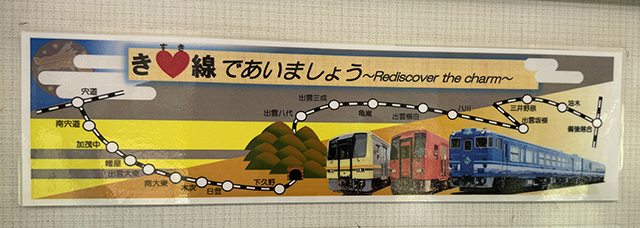
This line takes a bit of planning as there are not many trains that run on this line. The line runs between Shinji, connecting with the Sanin main Line and Bingo Ochiai where it connects with the Geibi Line. A distance of 81.9km.

It is a very rural line, with steep (for railway) gradients with a couple of switchbacks, lots of curves and plenty of scenic views.
In places the curves are very tight and the train is almost overhanging the embankments.


The country end of the Kisuki Line is Bingo Ochiai where it connects with the Geibi Line. Bingo Ochiai is a famous station for rail enthusiasts and at around 14:30 on the current train schedule the Bingo Ochidai rush hour occurs with the Kisuki Line train in the station and two Geibi Line trains (Hiroshima Pref) one for Niimi and the other for Miyoshi awaiting their departures.


Wakasa Railway – travel back to the Showa era in rural Tottori
The Wakasa Railway operates a 19.2 km single line in West Tottori between Koge (where it joins with the Imbi Line) and Wakasa. Many trains run through to / from Tottori on the JR Imbi Line.


It is well known for its old station buildings and its retro diesel cars. Wakasa Station in particular is famous for its original wooden station buildings with its ticket office and waiting room. In fact 23 facilities are listed by the Japanese Government as National Tangible Cultural Assets. This includes the station, turntable and water tower at Wakasa Station as well as other stations and facilities.
The railway very much reflects the Showa period.
The railways depot is also situated at Wakasa and has a fairly rare hand operated turntable and a couple of old locomotives:
- Steam Locomotive C12-167 dating from 1938. For ecological reasons it has been converted to operate on compressed air. It is operated on some weekends in the yard at Wakasa and also for providing driving experiences.
- Diesel Locomotive DD16-7 which previously was used at the Railway Technical Research Institute. It is also used for driver experiences and operating in the Wakasa station yard.
- There are also some old passenger cars (JNR series 12 cars)


Many of its diesel cars used on scheduled services are also retro style. This is a railway that gives you the feel that you are travelling back in the Showa era! Three of the 4 diesel rail cars also have names!

Ichibata Electric Railway (Bataden) – for the best views of Lake Shinji and access to Izumo Taisha
The Ichibata Electric Train Railway or Bataden as it is known locally runs two lines, The Kita Matsue Line between Densha Izumoshi station(close to JR Izumoshi Station) and Matsue Shinjiko Onsen station (33.9km) which runs along the north coast Lake Shinji and the Taisha Line (8.3km) between Kawato and Izumo Taishamae.
Travelling on the Bataden railway is one of the best ways to see Lake Shinji. Rather than the south side of the lake which the JR Sanin Main Line travels, the Bataden line travels on the north side and has more uninterrupted views of the lake. Some of the trains that travel on the Kita Matsue Line have seats arranged to give a better view of the lake. [It should be noted that there is a switch back at Ichibataguchi Station, so if travelling from Izumoshi, Kawato or Izumo Taisha you need to sit on seats that face the opposite direction to the lake ( i.e. facing westward) to be on the correct side of the train to view Lake Shinji later on your journey.


Views of Lake Shinji from the train


At the Izumo Taisha Mae Station there is a preserved former Bataden car DeHani 50 series train (no 52). the train dates back to 1927 and although on static display and can still operate under its own power.


JR Sakai Line – Celebrating GeGeGe no Kitaro
As we covered this line in another article, we will not say too much about it in this article, except to say that the trains and stations on this line that runs between Yonago and Sakaominato celebrates characters from the manga “GeGeGe no Kitaro”, which was created by Sakaiminato native Mizuki Shigeru. At Sakaiminato theer is the Mizuki Shigeru Road”, which features 177 bronze statues of “yokai” (spirit creatures).
The line also serves Yonago Airport, although you may be a bit surprised at how low key the station is for an Airport Station!
You can read more in this article

Travel Information
The key to exploring San’in by Train is planning your trip and doing some research beforehand. We would emphaise as well that getting to and from the area can also be part of the experience of your trip, particularly if you have time and are looking for a “slow holiday”
Except for the Wakasa Railway and the Ichibata Electric Railway JR Rail Passes can be used to travel around the region. Beware that Limited Express Yakumo and the night train Sunrise Express are all reserved seats so booking in advance is important. For local trains no booking is required. Both Wakasa and Ichibata Railways have 1 day passes,
TS Japan Rail can help you plan your trip, with both ideas and itinerary planning. Apps like Google Maps and similar navigation apps will not always come up with the desired route as their algorithms look for the fastest or cheapest route which may not necessarily be the most interesting route.
If you are not using a JR Japan Rail Pass we can also advise on other passes that are available or the best way to buy ordinary tickets.
For Rail Enthusiasts
The San’in regions rail network is also of interest to rail fans. There is a variety of different rolling stock in use:
- JNR 115 series (Yellow Livery) used on the electrified sections of the Sanin Main Line (Yonago~Nishi Izumo) and the Hakubi Line.
- JNR KiHa 47 DMUs on the Sanin Main Line and Sakai Line
- JR West KiHa126 and the 1 car version KiHa121 DMUs on the Sanin Main Line, Sakai Line & Hakubi Line
- JR West KiHa120 DMUs on the Kisuki Line (and Geibi Line)
- JR West Limited Express Kiha 187 DMUs (Limited Express Super Oki and Limited Express Super Matsukaze)
- JR West Limited Express 273 series (Limited Express Yakumo)
- JR West / JR Tokai 285 series Sunrise Express sleeper train units
Hakubi Line is one of the few lines where you can still see EF64 in regular service on freight trains operated by JR Freight.
Yonago Depot is situated adjacent and in full view of Yonago Station and you will often see special trains like the KiYa143 inspection train and KiYa140 snow plough there.
The other depot in the region is at Nishi Izumo.


Whether you want to See Japan by Rail or Explore Japan’s Railways, TS Japan Rail can help you plan your trip with ideas, designing travel itineraries, assisting with bookings and more.
We take the stress out of planning your trip and help ensure it is successful!
For more information on our services
see our homepage!


