
Table of Contents
The Maru Maru no Hanashi train 「○○のはなし」列車
The tourist train “Maru Maru no Hanashi” or 「○○のはなし」in Japanese, is operated by JR West and runs along the Japan Sea Coast of the San’in region between Shimonoseki and Higashi Hagi in Yamaguchi Prefecture. Never running far from the coastline, and often along cliff edges, the train offers scenic views of the sea and the rural tip of Honshu as it passes through villages and small towns.
It is a great way to see this part of Japan that is not so easy to travel around.
The name Maru Maru no Hanashi train 「○○のはなし」may be difficult for non Japanese (or non Japanese speakers) to understand . In fact it is a bit of a play on words…
- ○○or “Maru Maru” (maru means circle hence the ○○ symbols) and in Japan it is often used to indicate that you should insert the name (or correct word) in place of the “○○”. In this case it is meant to mean insert the name. There are many legendary stories associated with the area that the train travels through, so any of these could replace the ○○ (for example, Hagi, Nagato & Shimonoseki all have various stories associated with the cities or surrounding areas). Alternatively, as a visitor you or your fellow travellers may have your own story,
- Hanashi, in Japanese means a story, but for the train’s name it is cleverly derived from the first hiragana character of the three main places the train serves:
- “Ha” or 「は」for the city of Hagi
- “Na” or 「な」for the city of Nagato
- “Shi” or 「し] for the city of Shimonoseki, which is actually in the Sanyo region.
So put together ○○のはなし is meant to mean “someone’s or some place’s story”
The Train’s Route

For most of the train’s journey it travels along the Sanin Main Line, either along the coast line or very close to the coast. The train travels between Shimonoseki at the western tip of Honshu and goes via Agawa, Nagatoshi, Senzaki (on the return to Shimonoseki) with the eastern terminus at Higashi Hagi. At the Shimonoseki end, the train actually runs from / to Shin Shimonoseki for connection to the Sanyo Shinkansen (most shinkansen trains calling at Shin Shimonoseki are Kodama)
The train stops at the following stations besides Shin Shimonoseki and Shimonoseki:
- Kawatana Onsen 川棚温泉
- Kogushi 小串
- Takibe 滝部
- Kottoi 特牛 (outbound only
- Agawa 阿川 On both outbound snd return journeys has long stop (14 mins on outbound 10 mins on return)
- Hitomaru 人丸 on return journey has a 5 minute stop
- Nagatoshi 長門市
- Senzaki 仙崎* (on Senzaki branch line)Only on return journey – 34 mins stop; passengers have time to walk to Senzaki Michi no Eki
- Hagi 萩
- Higashi Hagi 東萩
(*) Senzaki is on a branch line that runs between Nagatoshi and Senzaki. The train on its return journey will change direction at Nagatoshi to travel on the branch to Senzaki.
The Train
The train itself is made up of two cars that have been refurbished to allow views of the coast (and inland) and comfort on what is nearly a 3 hour (outbound)~4 hour (return) journey.


The “Maru Maru no Hanashi “train is a converted KiHa 47 (47-7003 +47-7004). Prior to it becoming the Maru Maru no Hanashi it was used for the former Misuzu Shiosai (みすゞ潮彩) sightseeing train that also ran between Shimonoseki and Nagato / Senzaki. The service ran from July 2007 until January 2017. The Misuzu Shiosai train was ended due to the rolling stock aging (KiHa47s are JNR era trains), but rather than withdrawing the train, JR West decided to do a deeper renovation and the train was renamed as the Maru Maru no Hanashi.
Interior


Car 2 has a kiosk selling drinks and mementos. The seating arrangement in cars 1 and 2 are different
On board service
The train has a kiosk selling drinks (alcohol (particularly local craft beers, sake etc) & limited soft drinks) and mementos.
The train is staffed with concierges who as well as welcoming passengers on board will provide tourist information en route (note: Japanese only). Although we know that many rail fans do not like constant announcements over the train’s PA system, however it was useful for understanding an area, particularly if you have not been to before (in Japan, whether it is on a tour bus or tourist train you will likely hear lots of explanations)
Schedule, Fares & Reservations
The train generally only operates on Saturdays, Sundays and Holidays with one return trip on those days (it is not necessary to travel both ways or the full journey)
| Outbound Station | Outbound Time | Return Station | Return Time |
|---|---|---|---|
| Shin Shimonoseki | 9:54 | Higashi Hagi | 14:09 |
| Shimonoseki | 10:02 / 10:08 | Senzaki | 14:53 / 15:27 |
| Agawa | 11:26 / 11:57 | Nagatoshi | 15:34 |
| Nagatoshi | 12:17 /12:23 | Hitomaru | 15:52 / 15:57 |
| Higashi Hagi | 12:56 | Agawa | 16:13 /16:23 |
| Shimonoseki | 17:37 / 17:43 | ||
| Shin Shimonoseki | 17:50 |
Only stations with long stops where passengers can get off the train and other major station stops are shown. Where two times are shown, the first is arrival time and the second is departure time. Please refer to the timetable on the JR West website (link under “More Information”
The train is classified as a Rapid train. As well as the basic fare, a seat reservation is required (all seats are reserved) which costs ¥530. Bookings can be made on JR West’s Online Train Reservation Site. JR Japan Rail Passes and relevant Regional Passes can be used on this train (advance reservations required).
Meals
The “Maru Maru no Hanashi” train is not a restaurant or cafe train, but it is possible to pre order special obentos (packed lunches) made from local ingredients, that will be delivered on the train. You have to order via the dedicated website and seats in car 2 will be allocated.
“Japan admired the West, and the West admired Japan”
「西洋に憧れた日本(洋)、西洋が憧れる日本(和)」
Yamaguchi Pref and the Hagi area in particular, played a historical role in the Edo and Meiji eras, with influential figures connecting with the outside world and eventually helping with the movement that led to the Meiji Restoration and Japan opening up.
Scenery
The “Maru Maru no Hanashi “train is a great way to see this area of San’in, particularly as it is quite difficult to travel this route by ordinary train due to the low frequency of trains on some sections of the Sanin Main Line in Yamaguchi Prefecture.
The scenery you will see from the train is of course dominated by the Japan Sea. In many places the train is running very close to the sea, even along edges of cliffs. The train passes many fishing and coastal towns & villages.
In other places the train turns in land where you will see lush farm land.


Where are the best views – from the train
On the journey there are many sea views but there are also many Yamaguchi Prefecture rural views. There are a few spots where the train slows down or even stops so that passengers can take pictures.
- Both sides of Nagatoshi Station. Good sea views along the ragged Sea of Japan coast. This area between Nagatoshi and Kiwado is known as the Yellow Wave area, not because of the colour of the sea but because of the kanji use in the name Kiwado name (黄波戸 黄=Yellow; 波=wave; 戸 can mean door or gate) There is also an ancient legend that describes sacred object at the local Hachimangu (shrine) was carried ashore by yellow waves, hence the name of the district.
- Igami~Agawa The Sanin Main Line runs close to the sea in this area
- Nagato Futami~Uka Hongo – dramatic views of the sea, rocky coastline and hill.s
Interesting places to visit off the train
If you plan to take more than a day to do the route, here are some places it is worth spending some time at:
- Hagi City(萩市)
- Hagi Castle and old preserved town district – this is part of a Unesco World Heritage site
- Hagi Reverberatory Furnace part of the areas efforts to acquire western know how during the late Edo period (1856), this is a rare surviving tall furnace. It was an experimental furnace for casting western style cannon.
- Shōka Sonjuku Academy and Shōin Shrine the school building in the shrine grounds is another historical reminder of the part that Yamaguchi Prefecture and its local people played in the Meiji Restoration. Yoshida Shōin taught at the school, with several of his students going on to play important roles in the Meiji Restoration and bringing western concepts to Japan.
- Hagi Tourist Association website https://www.hagishi.com/en/
- Nagato City(長門市)
- Senzaki (仙崎) -the train actually stops at Senzaki (on the Senzaki branch) for about 1/2 hour allowing passengers to wander around.
- Motonosumi Shrine (元乃隅神社) – with its 123 red torii gates meandering for 100m by the coast this is regarded as one of Yamaguchi Prefecture’s finest scenic sites. It can be reached by taxi from Nagatoshi Station (40 mins) Hitomaru Station (20 mins) & Nagato Furuichi (20 mins) (Maru Maru no Hanashi train does not stop at Nagato Furuichi)
- The Nagato City Tourist website can be visited here https://nanavi.jp/en/
- Shimonoseki (下関)
- Karato Market although a wholesale market, at weekends and on holidays there are many stalls set up in the market selling fish, particularly Fugu, which Shimonoseki is famous for. Outside the market you have a great view of the Kanmon strait separating Honshu and Kyushu. There are also many restaurants and cafes around the market
- Kaikyo Yume Tower. This 153m tower (the tallest in Western Japan) gives a commanding view of the Kanmon Strait.
- Ganryujima 10 mins by boat from Karato Pier, Ganryu Island was the site of a 1612 famous battle which involved two of Japan’s best swordsmen (on opposing sides).
- Shimonoseki Tourist Association web site: https://shimonoseki.travel/en/
For Rail Enthusiasts
A good way to cover the western end of the Sanin Main Line
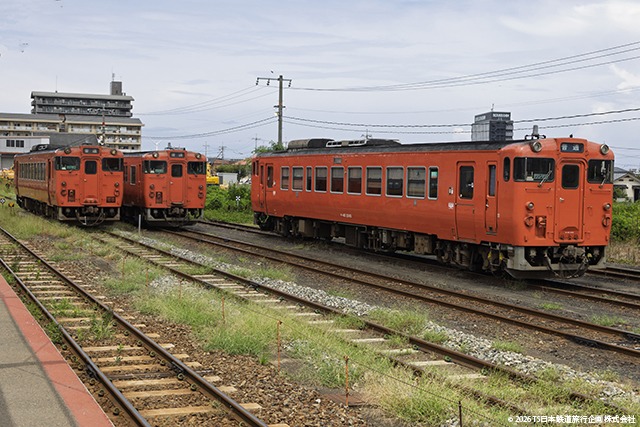
As already mentioned, the “Maru Maru no Hanashi” train is a converted 2 car KiHa47 diesel unit. KiHa 47s (part of the wider KiHa40 family) are Japan National Railways (JNR) era diesel trains which are gradually being phased out.
For those rail fans who like to cover different rail lines, the Maru Maru no Hanashi is a good way to travel on the Sanin Main Line, particularly west of Masuda, as the frequency of trains is very low in certain sectors, meaning long waits between trains. It also(on its return journey) travels via Senzaki on the Senzaki branch, which is not always easy to do due to the limited train schedule. (in fact on the day that TS Japan Rail travelled on the train, there were a few rail enthusiasts also travelling on it)
San’in Main Line rolling stock
Although the Kyoto~Kinosaki Onsen and the Hokidaisen ~ Nishi Izumo sections are electrified, the rest of the San’in Main Line is non electrified and much of it is single Line. At the western end trains are operated by KiHa 40 / 47 and Kiha 120 (JR West type; between Shinji~Masuda). As mentioned before the KiHa40 / 47 types are gradually being phased out, so this is a good area to still see them in operation.
Sanin Main Line – longest conventional line in Japan…
The Sanin main Line itself is the longest conventional line in Japan (673.8km, including the Senzaki branch) running from Kyoto to Hatabu (just before Shimonoseki) via Tottori, Matsue, Masuda, Hagi, Nagato and Agawa. There are, however, no regular services that run the full length of the line, although the JR West Cruise Train “Twilight Express Mizukaze” and the “West Express Ginga” do on an irregular basis when they do their Sanin / Sanyo itineraries.
Travel Information
- The train operates mostly on weekends and holidays. check the JR West site for schedule
- On operational days the train does one return trip Shin Shimonoseki->Higashi Hagi->Shin Shimonoseki.
- All seats are reserved. Please book at JR stations or on line (in English use the JR West train reservation site https://www.westjr.co.jp/global/en/ticket/overview/. The train only has limited capacity.
- Highly recommended that you reserve a seat on the sea side. Check JR Wets website page for which seats these are (https://www.jr-odekake.net/railroad/kankoutrain/marumaru_no_hanashi/)
- JR Rail Passes and relevant JR West Regional Passes are valid on this train.
- As this train basically caters for Japanese tourists, please note that most explanations on the train are in Japanese.
- Access to Shimonoseki is relatively easy (shinkansen to / from Shin Shimonoseki). Access to Higashi Hagi is possible by limited express and local train from Tottori, Matsue, Izumo (limited express to Masuda and local train to Higashi Hagi)
Find out more
JR West Tourist Train website
JR West Website Maru Maru no Hanashi page (Japanese only)
Yamaguchi Prefecture Tourist site
Other San’in Posts
- Exploring San’in by Train – Rivers, Sea, Mountains & Forests with lots of culture and good food!

- Special Train – West Express Ginga
- Tourist Trains – 「○○のはなし 」”Maru Maru no Hanashi” (Yamaguchi Prefecture Hagi~Shimonoseki)


Whether you want to See Japan by Rail or Explore Japan’s Railways, TS Japan Rail can help you plan your trip with ideas, designing travel itineraries, assisting with bookings and more.
We take the stress out of planning your trip and help ensure it is successful!
For more information on our services
see our homepage!


コメント