
If you have been to Japan….
What a lot of visitors to Japan comment on is how clean and free of litter and rubbish the trains (and everywhere) are. It is part of what in Japan can be described as Omotenashi . Like a lot of Omotenashi, it may look on the outside as ordinary, but behind the scenes a lot more is going on and there is a lot of pride and dedication amongst the people providing it. This is certainly true of the teams of people who are keeping the shinkansen clean and tidy and running on time at major stations around Japan.
Omotenashi is the Japanese term for ordinarily and often in the background providing special care and service for clients, customers and in this case passengers. Things like polite greetings, careful presentation, clean facilities, and staff trying to help in a natural way and not making the recipient feel like it is a burden are good examples of Omotenashi.
TS Japan Rail’s Turner recently took part in a TBS (Tokyo Broadcasting System a major TV channel in Japan) program segment that looked at how the shinkansen trains are cleaned between runs.
Watch the program on YouTube
Trains have to be turned around in 15 minutes (arrival to departure), including passengers disembarking and embarking…
Anyone standing on the Tokaido Shinkansen platforms at Tokyo station will notice that trains are departing every 3 to 9 minutes at busy times on an ordinary day with up to 11 departures an hour. On major holidays (New Year, Golden Week, Obon) the number of departures is even greater. You will also notice the teams of cleaners, or Dressers as JR Tokai calls them, lined up ready when the train arrives.
After the trains arrive at Tokyo Station, teams of “Dressers” board the trains, turn the seats and do a general clean up. They also collect rubbish from disembarking passengers, check for lost items, and check the train for left behind items. The work is planned with a high degree of precision and carried out with great dedication.
JR Tokai basically needs to turn around trains in 15 minutes to maintain its schedules, including disembarking and boarding by passengers…which means that cleaning crews need to do their work in 10 minutes, although in reality as they need to wait for passengers to disembark, they only have 8 1/2 minutes. (note: some trains are taken out of service and sent to the depot where cleaning takes place)

It takes around 40 people to clean a train…
2 people for each ordinary car (13 cars) and 4 people per Green (first class) car (3 cars) are involved, people per a 16 car train plus supervisors who check everything has been done..
For the railway company this is a very important job. It is important not just in terms of keeping passengers happy, they demand clean trains, but also in ensuring that trains run on time.
Dressers not Cleaners
In fact because of their importance, JR Tokai does not call them cleaners, but “Dressers”. The reason behind this is that JR Tokai (and other railway companies) see the cleaning teams as more than just cleaners, but as an important part of the operation that keeps passengers happy and trains on time.
Spending time with them, it is clear that their dedication, attention to detail and organisation is what keeps the trains clean and on time. This is something you do not realise watching from the outside.
It is a strict process, it has to be…
After all passengers have disembarked, the process follows a strict process
Greeting passengers as they disembark from the train
Dressers will also collect any rubbish the passengers have.
Check for left behind items…
Smartphones, tickets and souvenirs are the most common things left behind. Mirrors are used to check that nothing has been left on the overhead shelves, and seat pickets and window ledges are checked.
Turn seats
Seats have to be turned in direction of travel. On shinkansen this is done manually (on some trains this can be done automatically). Looks easy, but each ordinary car has between 13 & 20 rows of 3+2 seats (green car 17 rows of 2+2 seats). Each cleaner turns the seats on both sides for half the car.
Check for wet seats
Dressers use a special tool (the Express Thermot, see below) that checks whether seats are wet. Dressers carry super high absorbent towels to dry any seats that are wet.
Sweep floors / collect rubbish
There is a set way to sweep the floors. Any rubbish on window ledges, seats and seat pockets.
Empty rubbish bins / clean restrooms
Rubbish bins need to be emptied and restrooms cleaned.
When all is finished the team lines up on the platform and bows to passengers. Once the team leaders signal that the train is ready, the doors will be opened and passengers can embark.
Technology
Although mostly manual work, that has been carefully choreographed, there is a bit of technology that is used, which according to the Dressers helps their backs and knees. it is the…..
The “Express Thermot” エクスプレスサーモット

This is a device with a thermal camera that can sense damp seats. It not only saves the dresser having to bend down to check the seat, as required with the previous tool that was like a short handled brush with a sensor, it also saves time as the Express Thermot can check across each row of 3 or 2 seats. It is connected to a smartphone type device which not only highlights which seats need attention but also which part of the seat.
With around 300 trains a day, how does it work so smoothly?
Hidden away deep inside Tokyo Station is the “Dresser Control Room” which is the nerve centre of the whole operation. Here the supervisors can see on a large display which information on each train, including which platform and which Dresser Team is assigned.

The importance of this is that if there are any delays to trains or other problems the control room can reassign teams as necessary to ensure that trains get cleaned and can depart as quickly as possible.
Although probably not realised by most passengers, delays, whether just a few minutes to a single train or major disruption due to for example weather, do happen, but for the control room they normally only need to rearrange Dresser teams once or twice a month. The control room can contact the dressers on the platform by smartphone.
Also at the start of each team’s shift a roll call is held and any particular information required by the teams (extra trains, is shared at the roll call. For example on the day we visited, the start of the Obon rush was due to start , so many extra trains were operating from the afternoon.
And on the question “what happens if the train cannot be cleaned in time?” The answer was “It cannot happen”
Sounds easy but….
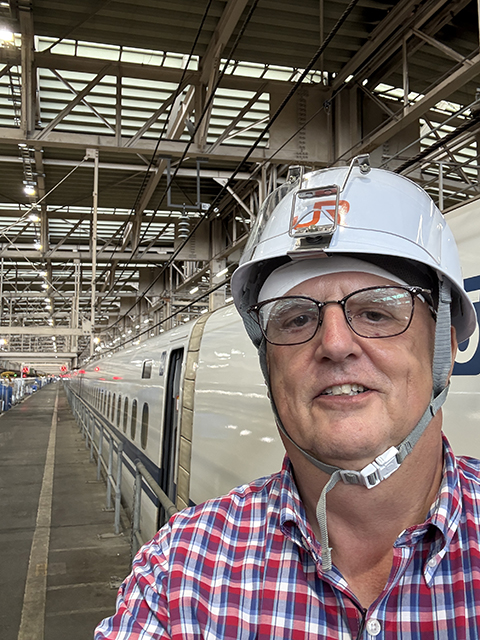
TSJR’s Turner practiced cleaning one shinkansen car at JR Tokai’s Tokyo Shinkansen Depot before it went into service…with the help of a couple of professionals he managed to do it in just over 9 minutes, which may be good for a first time, did not include greeting and taking rubbish off of disembarking passengers, so would have meant that had the train been at Tokyo Station, passengers would have been late embarking… (this part was cut from the program)
Unless otherwise stated all pictures are copyright Tokyo Broadcasting System (TBS)
Whether you want to See Japan by Rail or Explore Japan’s Railways, TS Japan Rail can help you plan your trip with ideas, designing travel itineraries, assisting with bookings and more.
We take the stress out of planning your trip and help ensure it is successful!
For more information on our services
see our homepage!
© 2026 TS日本鉄道旅行企画株式会社 TS Japan Railway Travel Planning Company Limited


コメント
コメント一覧 (1)
[…] We have published a story on this on our main website Click Here […]